 3057701ac1
- Add SQLite database package for hashrate history persistence with configurable retention
- Enhance dashboard with responsive stats bar, improved chart component, and worker selector
- Add terminal modal component for console output viewing
- Implement comprehensive E2E test suite with page objects pattern
- Add history API endpoints for historical data queries
- Update worker message handling with proper registration
- Add new UI pages structure with layouts and components
- Update Docker configuration for Go 1.24
- Add PostCSS configuration for Tailwind CSS processing

🤖 Generated with [Claude Code](https://claude.com/claude-code)

Co-Authored-By: Claude Opus 4.5 <noreply@anthropic.com>
7.1 KiB
7.1 KiB
P2P Multi-Node
Control multiple mining rigs from a single dashboard using encrypted peer-to-peer communication.
Overview
The P2P system allows you to:
- Control remote rigs without cloud services
- Aggregate statistics from all nodes
- Deploy configurations to remote workers
- Secure communication via encrypted WebSockets
Architecture
┌─────────────────────────────────────────────────────────────────┐
│                      CONTROLLER NODE                             │
│  ┌─────────────┐  ┌──────────────┐  ┌────────────────────────┐  │
│  │ NodeManager │  │ PeerRegistry │  │     Dashboard UI       │  │
│  │ (identity)  │  │ (known peers)│  │                        │  │
│  └──────┬──────┘  └──────┬───────┘  └────────────────────────┘  │
│         │                │                                       │
│  ┌──────┴────────────────┴───────────────────────────────────┐  │
│  │                    WebSocket Transport                     │  │
│  │       SMSG Encryption  |  Message Routing                 │  │
│  └──────────────────────────┬────────────────────────────────┘  │
└─────────────────────────────┼───────────────────────────────────┘
                              │
        ┌─────────────────────┼─────────────────────┐
        │                     │                     │
        ▼                     ▼                     ▼
┌───────────────┐     ┌───────────────┐     ┌───────────────┐
│  WORKER NODE  │     │  WORKER NODE  │     │  WORKER NODE  │
│  rig-alpha    │     │  rig-beta     │     │  rig-gamma    │
│  ────────────│     │  ────────────│     │  ────────────│
│  XMRig       │     │  TT-Miner    │     │  XMRig       │
│  12.5 kH/s   │     │  45.2 MH/s   │     │  11.8 kH/s   │
└───────────────┘     └───────────────┘     └───────────────┘
Node Roles
| Role | Description |
|---|---|
| Controller | Manages remote workers, sends commands |
| Worker | Receives commands, runs miners |
| Dual | Both controller and worker (default) |
Setting Up
1. Initialize Node Identity
On each machine:
# Controller node
./miner-cli node init --name "control-center" --role controller

# Worker nodes
./miner-cli node init --name "rig-alpha" --role worker
2. Start P2P Server
# Start with P2P enabled (default port 9091)
./miner-cli node serve --listen :9091
3. Add Peers
From the controller, add worker nodes:
./miner-cli peer add --address 192.168.1.100:9091 --name "rig-alpha"
Or via the UI:
- Go to Nodes page
- Click Add Peer
- Enter the worker's address and name
Node Identity
Each node has a unique identity:
- Node ID - Derived from public key (16 hex characters)
- Public Key - X25519 key for encryption
- Name - Human-readable name
Identity is stored in:
~/.config/lethean-desktop/node.json
~/.local/share/lethean-desktop/node/private.key
Peer Management
Viewing Peers
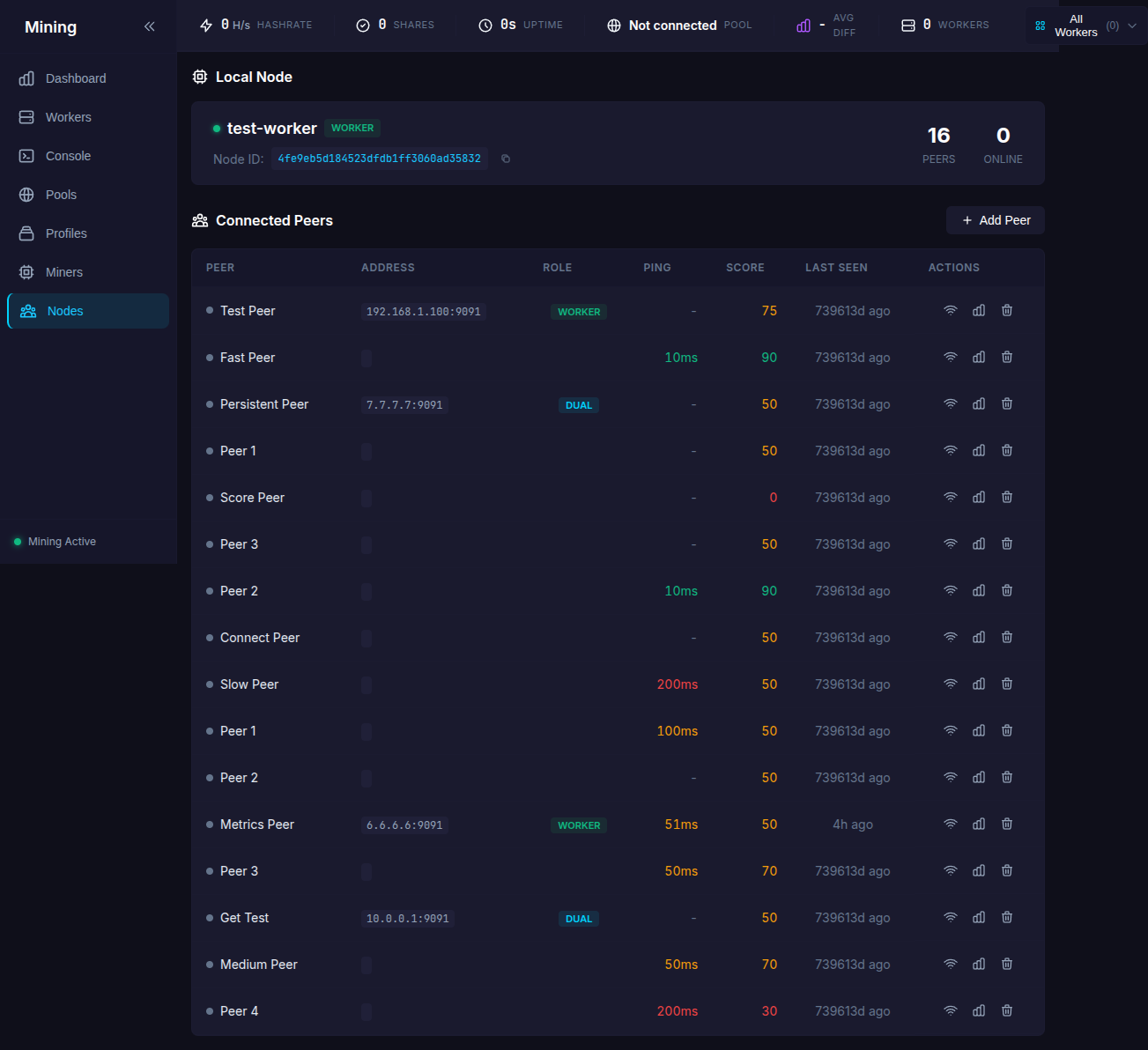
The Nodes page shows all registered peers with:
| Column | Description |
|---|---|
| Peer | Name and online indicator |
| Address | IP:Port |
| Role | worker/controller/dual |
| Ping | Latency in milliseconds |
| Score | Reliability score (0-100) |
| Last Seen | Time since last communication |
Peer Actions
| Action | Description |
|---|---|
| Ping | Test connectivity and update metrics |
| View Stats | Show miner stats from this peer |
| Remove | Delete peer from registry |
Remote Operations
Get Remote Stats
./miner-cli remote status rig-alpha
Start Remote Miner
./miner-cli remote start rig-alpha --profile my-profile
Stop Remote Miner
./miner-cli remote stop rig-alpha xmrig-123
Get Remote Logs
./miner-cli remote logs rig-alpha xmrig-123 --lines 100
Security
Encryption
All communication is encrypted using:
- X25519 - Key exchange
- ChaCha20-Poly1305 - Message encryption (SMSG)
- Message signing - Ed25519 signatures
Authentication
- Handshake verifies node identity
- Only registered peers can communicate
- No anonymous connections
Private Key Protection
- Stored with 0600 permissions
- Never transmitted over network
- Auto-generated on first run
API Endpoints
Node Management
GET  /api/v1/mining/node/info     # Get local node info
POST /api/v1/mining/node/init     # Initialize node identity
Peer Management
GET    /api/v1/mining/peers           # List all peers
POST   /api/v1/mining/peers           # Add a peer
DELETE /api/v1/mining/peers/{id}      # Remove a peer
POST   /api/v1/mining/peers/{id}/ping # Ping a peer
Remote Operations
GET  /api/v1/mining/remote/stats              # All peers stats
GET  /api/v1/mining/remote/{peerId}/stats     # Single peer stats
POST /api/v1/mining/remote/{peerId}/start     # Start remote miner
POST /api/v1/mining/remote/{peerId}/stop      # Stop remote miner
GET  /api/v1/mining/remote/{peerId}/logs/{miner} # Get remote logs
CLI Commands
# Node commands
miner-cli node init --name "my-rig" --role worker
miner-cli node info
miner-cli node serve --listen :9091

# Peer commands
miner-cli peer add --address 192.168.1.100:9091 --name "rig"
miner-cli peer list
miner-cli peer remove <peer-id>
miner-cli peer ping <peer-id>

# Remote commands
miner-cli remote status [peer-id]
miner-cli remote start <peer-id> --profile <profile-id>
miner-cli remote stop <peer-id> [miner-name]
miner-cli remote logs <peer-id> <miner-name> --lines 100
Network Requirements
- Port 9091 (default) must be accessible
- TCP WebSocket connections
- Optional TLS for additional security
Firewall Rules
# Linux (UFW)
sudo ufw allow 9091/tcp

# Linux (firewalld)
sudo firewall-cmd --permanent --add-port=9091/tcp
sudo firewall-cmd --reload